Quick answer: A family record links every member of a household, along with their policies, investments, loans and important dates, in one place. It helps you answer questions quickly, spot gaps such as a parent without health cover, and look after the whole family instead of just one person.
In most Indian households, money decisions are not made alone. The husband may buy term insurance, the wife may run the SIPs, the parents need health cover, and everyone is thinking about the children’s education. Yet many advisors still keep each person as a separate row in a sheet, with no link between them.
When you see the family as one unit, your work becomes easier and your advice becomes better. This guide explains what a family record is, why it matters, what to record, and how to build family records step by step.
What is a family record?
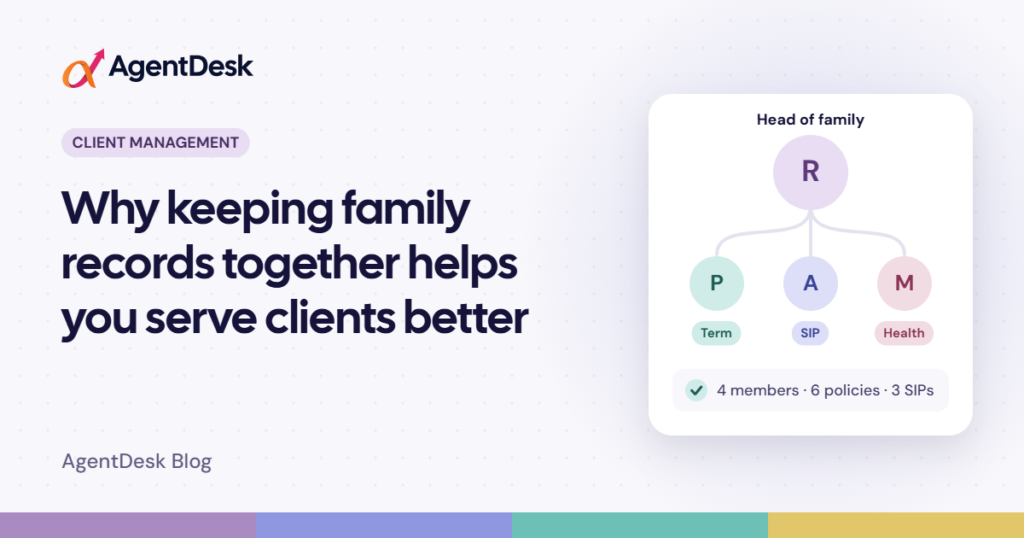
A family record is a single view of a household. One person is the head of the family, usually the main earner or decision maker, and every other member is linked to them with their relationship: spouse, child, parent and so on.
For example, the Sharma family record might show Rajesh as the head, his wife Priya, their two children and Rajesh’s mother. Open the record and you see everyone’s policies, SIPs, fixed deposits, loans, nominees, birthdays and upcoming renewal dates together, instead of searching five different places.
Why family records matter
1. You see the full picture
When records are separate, it is easy to miss things. In a family view you can see at a glance that Rajesh has term cover but Priya does not, or that his mother’s health policy renews next month. These are exactly the details clients expect their advisor to know.
2. Better advice, not just more sales
Looking at the whole family helps you spot real needs. Perhaps a family floater would suit them better than separate health policies, a nominee needs updating after a marriage, or a child’s education goal has no SIP behind it yet. Advice based on the full picture builds trust, and trust is what brings repeat business.
3. Fewer missed dates
A typical family can have many policy renewals, SIP instalments, FD maturities and birthdays every year. When all of them sit on one family timeline, you are far less likely to miss one. A missed renewal for a client’s parent hurts the relationship just as much as a missed renewal for the client.
4. Faster service on the phone
When a client calls and asks, “What is my mother’s policy number?” or “When does my son’s FD mature?”, you can answer in seconds instead of promising to call back.
5. Stronger relationships that last
Families who feel well looked after tend to stay with their advisor for years. When the children start earning, the advisor who already knows the family is the natural first call.
6. Easier family reviews
A yearly review meeting is much simpler when everything is in one place. You can walk the family through what they have, what is due and what is missing, without preparing a stack of printouts.
What to record for each family member
- Name, relationship to the head of family and date of birth
- Mobile number and email
- KYC status: PAN, address proof and bank proof received or pending
- Insurance policies, with nominees and renewal dates
- Investments such as mutual funds, SIPs, fixed deposits and bonds
- Loans, with EMI and end dates
- Important dates: birthdays, anniversaries and maturities
- Meeting notes and documents
Only record what you actually need to serve the family. Tell clients what you keep and why, ask for their consent, and keep the information safe. India’s Digital Personal Data Protection Act, 2023 expects personal data to be handled with this kind of care.
How to build family records, step by step
- Start with your best clients. Pick your top 20 or 30 clients and create a family for each, with the client as head of the family.
- Link people you already have. Many families are already in your list as separate clients. Link them instead of creating duplicates.
- Ask one simple question. At your next meeting, ask: “Who else in the family depends on you, or might need cover?” Add those members.
- Record nominees properly. Check every policy’s nominee against the family list. Mismatches are common and worth fixing early.
- Plan one family review a year. Schedule it around a natural date, such as the main policy’s renewal.
- Update after life events. Marriages, births, new jobs and retirements all change what a family needs.
Life events worth a conversation
| Life event | What to review with the family |
|---|---|
| Marriage | Nominees, cover for the spouse, shared goals |
| Birth of a child | Life cover amount, adding the child to health cover, an education plan |
| New home loan | Whether life cover is enough to repay the loan |
| Parents retiring | Health cover and regular income needs |
| Child starts working | Their own health and life cover, and a first SIP |
How AgentDesk helps
In AgentDesk you create a household, select the head of the family and add or link family members. Each customer page shows the person’s portfolio, policies, claims, bonds, fixed deposits, mutual funds, loans, meetings, referrals and documents in separate tabs, and the customer timeline shows renewals, maturities, SIP instalments and claim follow-ups, with overdue items clearly marked.
Checks on PAN, Aadhaar and GST help prevent duplicate records, and you can filter clients by age, family role or proof status to prepare review lists. Team members only see what their role allows, and documents are stored in your own Google Drive, as explained on our security page. Whether you are an insurance agent or a mutual fund distributor, you can book a free demo of AgentDesk.
Frequently asked questions
Do I need the client’s permission to record family details?
It is good practice to tell clients what you record and why, take their consent, and keep only what you need. This builds trust and matches the spirit of India’s data protection law.
Who should be the head of the family?
Usually the main earner or the person who makes financial decisions. It is simply a way to organise the record, and you can change it later.
What if some family members use another advisor?
Record only what the family chooses to share with you. Even knowing that a parent has health cover elsewhere helps you avoid suggesting something they already have.
How often should I review a family’s records?
At least once a year, and after any major life event such as a marriage, a birth or a new loan.